We're "ON" It! - The Owen News
The Owen News is your trusted source for comprehensive, reliable and unbiased local news and information in Owen County and surrounding areas, including Spencer, Gosport and more.
Stay in the loop!
Subscribe to The Owen News and receive news alerts and other important notifications directly to your inbox! Or log in below if you've already subscribed.
Welcome back, user.name!
Readers like you make our nonprofit news organization possible. Have you considered advertising with us? Also, as a monthly member, you can get The Owen News delivered to your home for as low as $5 per month!
Featured Stories


.avif)


Support The Owen News!
Your support fuels independent journalism and community engagement. As a recurring monthly donor, you can get newspapers delivered straight to your doorstep (if you'd like)!
Latest Stories


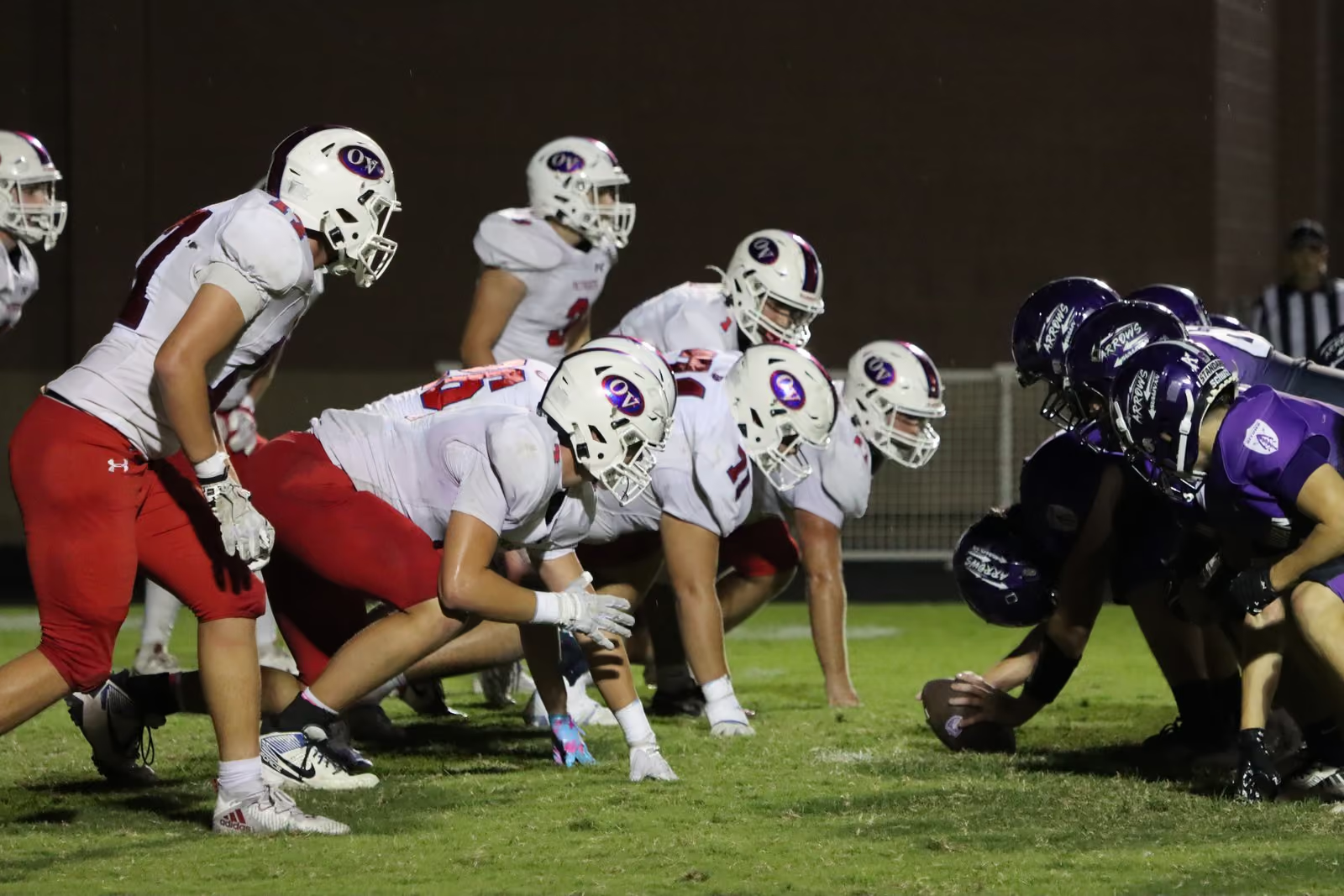
Owen Valley Homecoming vs West Vigo
Photos from Owen Valley’s homecoming: the 2026 court, student section, cheerleaders, Patriot Band and Guard, and a 19-14 win over West Vigo.

Remembering Owen County’s Black pioneers: Walden Cemetery honored with new state marker
On a bright, sunlit Saturday afternoon, community members, historians, and descendants gathered Oct. 10 for a solemn and uplifting unveiling ceremony at the historic Walden Cemetery. Set against a tranquil backdrop of early autumn trees, the gathering marked a milestone in local historic preservation.
The afternoon program highlighted the deep historical significance and decades-long preservation efforts surrounding the sacred grounds, located just west of Spencer along Hillcrest Drive.
A Sacred Resting Place
Historian and documentarian Elizabeth Mitchell opened the formal presentations by reflecting on the spiritual weight of the property and the urgent need to reclaim its history from the ravages of time.
“This cemetery is more than a piece of ground. It is a sacred resting place. It is a record of lives lived, families formed, hardships endured, as well as contributions made to the history of Owen County,” Mitchell said. “The people buried here were part of the foundation of a community and deserved to be remembered with dignity and respect. Unfortunately, over time this cemetery has been neglected. When a cemetery is neglected, the memory of the people buried is placed at risk. Headstones, names, family histories can fade away from public awareness.”
Rather than leaving the site to decay, Wilson framed the current efforts as a crucial turning point to reclaim its history.
“With care, recognition, and action, we can restore honor to this historic site,” Wilson explained. “This site is historically notable for being the resting place of several Civil War veterans who served in the United States Colored Infantry and the United States Colored Troops. It is one of the few historically documented African American burial grounds in Indiana. Very few visible headstones are left; the rest have been desecrated. Your presence here today is a step closer in recognizing and remembering the community members buried here who were once a significant part of this county and our country.”
A Tumultuous Era
Videographer Bob Appleman, who collaborated with Mitchell on a documentary project for The Nature Conservancy, spoke next about the volatile political and social climate that greeted Black pioneers settling in Owen County during the early 1800s.
“Studying the history of this area, especially the Black families who helped develop this area in the 1830s, you don’t realize how tumultuous the time period was before the Civil War,” he said. “You had the federal government doing one thing, and then the state governments doing another that was absolutely opposed. So, to be a Black in this area was a pretty tenuous existence. But one thing that I found in studying the history [of the area] was that the Spencer community was one of the largest communities in the state because there was a sense of the culture and respect for the culture. This cemetery, and the fact that it could exist, is a statement to the group of people that were living here at that time.”
Walden Legacy and Civil War Sacrifice
Local historian, author, and former newspaper reporter Dixie Kline Richardson stepped forward next to trace the migration of free Black families, such as the Waldens, from North Carolina to Indiana decades before the outbreak of the Civil War.
“The Waldens were among a large group of Black families migrating from North Carolina to Indiana and were in Owen County three decades before the Civil War,” Richardson began. “Seven Walden men are listed as landowners in Owen County Deed Book 1, including Richard Walden, on whose land we are gathered. He gave this ground for a cemetery for his family, including the Wilsons, and his friends in 1842.”
Richardson highlighted the military service represented in the cemetery by focusing on one soldier’s story.
“Let me have Joseph Walden represent the veterans of the war whose bodies were buried here,” she said. “He was living in Orange County in 1860, where several families had settled, and there he enlisted in the United States Colored Troops in 1863. He was 25.”
Pointing to a blank headstone nearby, Richardson noted the mystery surrounding his final resting place.
“Joseph didn’t leave much of a paper trail, and here stands his stone with no inscriptions, evidently identified by someone who knew,” she explained.
Through research at the National Archives, Richardson uncovered key details of Joseph’s wartime service and its lasting personal toll.
“His unit, Company D, 28th Infantry, fought in some of the worst battles, including the Siege of Petersburg, Virginia, and the Battle of the Crater, when the dynamiting for a tunnel went wrong and killed troops in a friendly fire tragedy,” Richardson recounted. “He was discharged as a corporal in the field because deafness from the shelling from gunboats rendered him unfit for service.”
Following his military discharge, Joseph made his way back to Owen County.
“I don’t know if Joseph married. I don’t know when he came to Owen County—surely, it was to reunite with relatives,” Richardson reflected. “I don’t know much more about Joseph. I don’t know what caused his death when he was 34. I do know that he lived out those last eight years of his life in silence.”
Closing her remarks, Richardson reflected on the broader meaning of the sacred grounds and the enduring debt owed to those buried there.
“We don’t know the individual life experiences of those interred in this cemetery, but we do know by these markers that they existed,” Richardson said. “Their lives had meaning, and we need the visual testimonies that they were here.”
Ancestral Pride
Vivian Bridgewater, a direct descendant of the Wilson family, addressed the gathering to express deep gratitude for the renewed public recognition of her ancestors and their enduring contributions.
“I just want to thank all of you for being out here this afternoon. I am a proud descendant of John and Adeline Wilson. They also have roots in Owen County and the Lick Creek settlement that you spoke about, Mr. Walden coming up from that area,” she said. “I’m proud, especially in today’s environment, to be able to stand here as a surviving descendant of these families and these veterans, Civil War veterans, World War veterans, in my family on the Wilson side and on the Thomas side. There’s been so much said to belittle the contribution of African Americans that it does my heart good to see people stand out here and recognize not just where they lay, but what they contributed.”
Uncovering Hidden History
Owen County Historian Dr. Tony Neff later shared his ongoing amazement at the rich tapestry of local Black history that continues to surface through archival and community research.
“I’m really proud of what’s going on here,” Neff said. “I’ve been [researching] the history of Black Americans in Owen County for some time, and it always surprises me when some new thing comes up. Like years ago, I didn’t know we had a school or we had a church. And then, I found out about [this] cemetery and one of the first things I did was come here, try to figure out what was going on, and find ways to bring it back to life and get recognition.”
Preserving the Archival Record
Jason Kinney of the Owen County Historical & Genealogical Society (OCHGS) opened his remarks by expressing gratitude to Mitchell for securing the Indiana Cemetery Heritage sign and organizing the day’s program. Kinney then paused to honor the late Roger Peterson, who served for many years as the Owen County Historian and Archivist and remained an active member of the OCHGS from 1990 until his passing in 2003.
“Roger was instrumental and a driving force in organizing the old county records into the Owen County Archives,” Kinney said. “A special interest of his was researching the African American history of Owen County. Roger said, ‘African Americans were among the pioneers of Owen County and did their share in contributing to the development of the county.’ He felt it was important that their story be told.”
Kinney recounted how Peterson’s extensive local research began in 1990 while searching for a serious research topic. A chance encounter with Coy D. Robbins, president of the Indiana African American Historical & Genealogical Society, while waiting at a copy machine at Kinko’s in Bloomington sparked a pivotal collaboration. Sharing Peterson’s own account, Kinney noted:
“During the conversation the thought occurred that I might have found the subject. I made a preliminary search of Owen County records and thought such an investigation might be fruitful. I then asked Coy if he would like me to research Owen County records for references to African Americans. He responded affirmatively and during a few meetings he coached me as to things I should look for. I then began a search for every reference I could find, in every record book, in the courthouse to discover what the research would reveal.”
Following this deep dive into county records, Peterson published his findings in a book, as well as in the local newspaper and the historical society’s magazine. Kinney pointed out that years ago, Peterson and the historical society originally installed a historical sign about Walden Cemetery, which has now been carefully recreated to be reinstalled soon.
Decades of Community Stewardship
Nancy Lorenz, a well-known local resident and former educator who lives across from Walden Cemetery, spoke about her decades of collaboration with students from Indiana University’s Atkins Living-Learning Center to protect the burial site. The Atkins LLC is a residential community at IU Bloomington focused on academic excellence, leadership, and African American history and culture.
Reflecting on her four decades at the university and her long-standing collaboration with students, Lorenz explained that introducing them to the cemetery was a vital part of their personal and academic development. She frequently welcomed students to her home and brought them to the historic site at the start of each academic year to impress upon them its significance. Although many of the original headstones have vanished, Lorenz preserved a collection of historical headstone rubbings created by her students over the years, adding invaluable documentation to the site’s ongoing legacy.
Summing up her deep personal connection to the hallowed grounds, she reflected that while she does not own the property, she has always felt like its dedicated “caretaker.”
Lorenz also highlighted the creation of a new entrance sign—a recreation of one her father had built years earlier—by friend Mike Bruner. The sign is constructed out of 200-year-old poplar wood from New Harmony, IN, featuring an official 1860s coin-reverse eagle emblem.
Libation Ceremony and Roll Call
The afternoon’s events culminated in a traditional African libation ceremony, officiated by Mitchell’s cousin, Carolyn Tillman, who was visiting from California. Following the African proverb that “people who lack knowledge of their past are like a tree without roots,” cool water was poured into the earth to purify and nourish souls while invoking the ancestors. After each name was called, the audience joined in unison with the Swahili affirmation, “Asé” (pronounced Ah-Shay, meaning “So be it”):
- E. L. B. (1848 – unknown)
- John Boon (1810 – unknown)
- Ellen Burnett (March 1846 – unknown)
- Leonard O. “Len” Burnett (Nov. 24, 1855 – Jan. 21, 1919)
- J. C. Cline (1842 – April 21, 1908) — Co. D, 28th United States Colored Infantry
- Clorenda Evans (Aug. 1, 1847 – April 1, 1892)
- Nettie Evans (Dec. 14, 1865 – March 18, 1872)
- Sarah A. “Sadie” Cole Hayes (May 26, 1856 – Sept. 8, 1909)
- William Hayes (1856 – unknown)
- Mary Magazine (Aug. 8, 1856 – April 2, 1864)
- Baby Powell (Oct. 2, 1841 – Oct. 2, 1841)
- Elizabeth “Betsey” Walden Powell (1810 – Oct. 2, 1841)
- Lincoln “Link” Reid (Aug. 16, 1860 – Aug. 6, 1905)
- Leanna Walden Scott (1819 – unknown)
- Charles Wagstaff (April 13, 1862 – Oct. 25, 1930)
- Hannah Garlits Wagstaff (Feb. 10, 1869 – Feb. 10, 1910)
- Morton Wagstaff (Nov. 16, 1869 – Oct. 22, 1966)
- Jesse Walden, Sr. (1795 – unknown)
- Joseph Walden (1838 – Feb. 17, 1872) — Co. D, 28th United States Colored Troops
- J. M. Wilson — Co. D, 28th United States Colored Troops
- J. T. Wilson — Co. H, United States Colored Infantry

Sparking curiosity: Owen County fourth graders learn agriculture safety up close
The Owen County Fairgrounds was abuzz with activity Oct. 7 as fourth graders from Spencer, Gosport, Patricksburg, and McCormick’s Creek elementary schools attended Ag Safety Day. The event, organized by the Spencer-Owen Community Schools (S-OCS) Agriculture Department with the help of Owen Valley FFA, showcases various agriculture related careers as well as safety information provided by local businesses and first responders. The event is meant to give students the opportunity to interact with aspects of these fields up close.
“The idea from our side was to bring different industries, different people, professionals that interact with different levels of safety that they might interact with in their daily lives, so it’s more applicable to them,” said Owen Valley agriculture teacher and FFA advisor Josh Schonfeld.
Students started off their morning with a demonstration from South Central Indiana (SCI) REMC. Several demonstrations of the dangers of high voltage electricity were shown using a model of typical power lines hooked up with actual powerline voltages. REMC linemen roasted hot dogs with electricity arcs, burned an orange from the inside out and set a tree branch on fire to the awe and excited murmuring of the attending students.
The students then separated into groups to hear from representatives from the Owen Valley Fire Territory, Owen County EMS, All Pro Tree & Land Service, Frye Towing and Recovery, the Department of Natural Resources, Strouse Farms & Trucking, and Diana Curry of Curry Farms.
The Owen Valley FFA was also on hand, volunteering as group leaders and helping to coordinate the fourth graders.
“We have a really involved FFA and we are trying to build on that,” said Owen Valley Middle School agriculture teacher and FFA Advisor Emili Weddle.
She also noted that a lot of different parts of the community had to come together to make the day a success.
“We have been planning and making phone calls and reaching out to our teachers, and community members,” she said. “They say it takes a village, and it literally does.”
The event is a variation of traditional “Ag Day” events hosted in the past that usually involved some sort of farm animal petting zoo. Now, instead, “Ag Safety Day” is a broader showcase of jobs within the agriculture field and safety demonstrations.
“Historically it’s been more of an education of agriculture in general,” said Schonfeld. “In my prior county, the safety aspect was always the focus because a lot of times [the kids] would already have pet an animal, they may have animals, but [they] may not know how to act around the greater aspects [of ag technology]. Most likely they are interacting with at least one industry professional safety item that they’ve probably never been around before.”
For a fourth grader, a field trip where they get access to heavy machinery and watch people interact with electricity is pretty exciting. At least Weddle thinks so.
“Every student loves a good field trip, especially a fourth grader,” she said, “but we just want them to be really involved, so to see the smiles on the kids, and for them to look at each demo… to see their smiles and to learn the information and the ag safety that we really want them to see…[to] kind of spark those interests and excitement.”
Local agriculture-related businesses that would like to participate in next year’s Ag Day event should contact the Owen Valley High School office at 812-829-2266 and ask to speak to the Ag Department.

Spencer Pride at 20: New director, same mission
A lot can happen in 20 years, and for Spencer Pride, it’s hardly an exception. The Spencer Pride commUnity center moved from the south side of the square to the north side. The center expanded into the building next door and added an elevator, a library, and a meeting room. The Pride Festival that once took place on the Owen County Courthouse lawn in June, now wraps around the Spencer town square on Main, Franklin, Market, and Washington streets and takes place in October. In 2026, the Pride Festival brought with it Spencer Pride’s first-ever executive director in Jake Taylor.
Taylor has had a long career working in nonprofit organizations, starting after they graduated from Bloomington High School South and attended Indiana University where they studied journalism and gender studies.
“I interned at several nonprofits and then after college, I think I was frustrated with how hard nonprofits work, with what can feel like small potatoes, like you’re working really hard for small wins,” Taylor said.
After college Taylor joined AmeriCorps NCCC, and led a team of seven that assisted the U.S. government with COVID relief and flood relief in Queens, NY among other things. This experience led them to eventually join the Peace Corps and move to Togo, West Africa where they continued their efforts to improve quality of life.
“I felt really honored to work in that space,” Taylor said. “[I made] really unique friendships and worked on different community projects, including a women’s gardening cooperative initiative. I worked with the middle school [where] I taught many, many, many students. [I helped with a] gardening club, English learning groups, [and] lots of farming, cooperative work.”
Taylor sees their work in West Africa as broadly similar to what their duties will be as executive director of Spencer Pride, namely, reaching out to local community aid organizations and bringing people together in order to improve the community for everyone.
While working in West Africa, Taylor rediscovered their interest in queer and gender studies issues and began additional study in Helsinki, Finland where they earned a master’s degree in intercultural encounters. By then, a desire to be closer to family and the opportunity to work as the executive director of Spencer Pride brought them back to the area.
“I was in Finland, and I was looking through jobs, four jobs in Finland, in Europe, in D.C., in bigger cities in the states. And then obviously here in Indiana, just because I had that experience and family was here,” Taylor said. “And so I moved for it. I was looking everywhere, but I think the main draw was the work, but another draw was certainly that I’m from here.”
Taylor is excited to work with Spencer Pride on what they see as a group that has established itself as an integral part of the community.
“I think it’s really important for queer kids, LGBTQ folk, especially rural folk, to have representation, and one thing [Spencer Pride has] done especially well is being visible. You are right on the square, if you become a part of a community where you’re watering the plants, where you are volunteering for other organizations, like [Spencer] Main Street, when you’re working with the Chamber, with the Owen County Community Foundation, it just really shows that you’re not, you’re not [just] in this for the LGBTQ folk. You’re in this for the community,” Taylor said. “We’re making it a space where everyone feels welcomed and included.”
Taylor sees the transition from a fully volunteer-led organization to one led by a paid employee as being a potential challenge on the horizon for Spencer Pride, comparing it to the challenges of growing up.
“I think we are in a really special moment for Spencer Pride’s history. If you think about the development of nonprofits, it normally starts with a few people and a really good idea,” Taylor explained. “So that’s like conception, and then you get into infancy or childhood, where you are learning a lot and growing a lot . . . but then you get to a point where a lot of leaders are taking on so much responsibility. We’re at this time that’s exciting because they’re going from all-volunteer, to having a staff person who isn’t working full-time on anything else. So it can invest the time and energy into [its] goals. It’s a really interesting transition to go from something volunteer led to staff led . . . [sometimes] it’s a little bit awkward, as we redefine what roles look like and how we can best support each other.”
Coming into Spencer Pride with a 20-year legacy behind it, Taylor hopes that they can take what Spencer Pride has done and add their own skills to help the organization thrive in the future.
“I feel really honored [and] I think often fearful. A lot of LGBTQ folk, we have this idea of elders. These are people who kind of created the landscape for the current youth to survive. I think I have directly benefited from others who have paved a way for me,” Taylor explained. “I’m 27, so 20 years ago I was seven years old, and I recognize how every generation has kind of built on each other, and I’ve been really lucky to get to know some older professionals, retired folk, and people who’ve been in this community to tell me what has happened, [and] share their histories and their experiences. I feel really lucky that they have worked this hard for themselves, but also for me. I think stepping in, I come humble, but also with some confidence. I want to continue the fight and I think I have the skill set and the means to do so. My dream is to be [that] elder for some little kid. So I’m excited to continue on with that legacy.”
The 2026 Spencer Pride Festival on Oct. 2 brought its usual crowd, from local vendors and artists to other charitable organizations from around the area to visitors from all over the state. Their theme, Changed for Good, is meant to represent their commitment to changing things for the better, something Taylor hopes is in store for Spencer Pride and the community as a whole.
“I want [people] to know, you’re welcome with us,” Taylor said. “Joy is a real power and a real strength and I think, especially right now, I’ve been focusing on how I can exhibit that joy and welcome people in . . . we want to know you, to understand your concerns, and [we] move forward together because the mission of Spencer Pride is to improve the quality of life for LGBTQ people and rural people. That includes all of us.”
Get to know Spencer Pride’s Jake Taylor (they/them)
- Favorite movie: Currently, “9 to 5”
- Favorite TV show: “Parks and Recreation” (love Amy Poehler)
- Favorite book: “Beloved” by Toni Morrison
- Favorite thing to do outside of work: Hiking
- Favorite band or musician: Beyoncé, all the way back to the Destiny’s Child days
A fresh start: State officials announce $25 million plan for new MCSP campground
Governor Mike Braun and the Indiana Department of Natural Resources (DNR) have released formal plans for a modernized, expanded campground at McCormick’s Creek State Park (MCSP) east of Spencer. The announcement marks a major milestone in the recovery of Indiana’s first state park following the devastating EF-3 tornado that struck the property in March 2023.
“As Indiana’s first state park, McCormick’s Creek has been a place where families and friends have gathered and created memories for more than a century,” Governor Braun said in a news release. “The tornado in 2023 was a heartbreaking moment in the park’s history, but we are now ready to rebuild this campground stronger, more resilient, and better suited for today’s visitors. We look forward to welcoming campers back to camp once construction is complete.”
The late-night storm on March 31, 2023, packed peak winds of nearly 150 mph and cut a destructive 400-yard-wide path through roughly 282 acres of the park. The campground suffered catastrophic damage, toppling most of the surrounding mature trees and destroying over 90% of the sites in key loops, alongside all three campground shower houses. Following extensive multi-year debris removal, root ball extraction, and site cleanup, the grounds are finally clear and prepared for rebuilding.
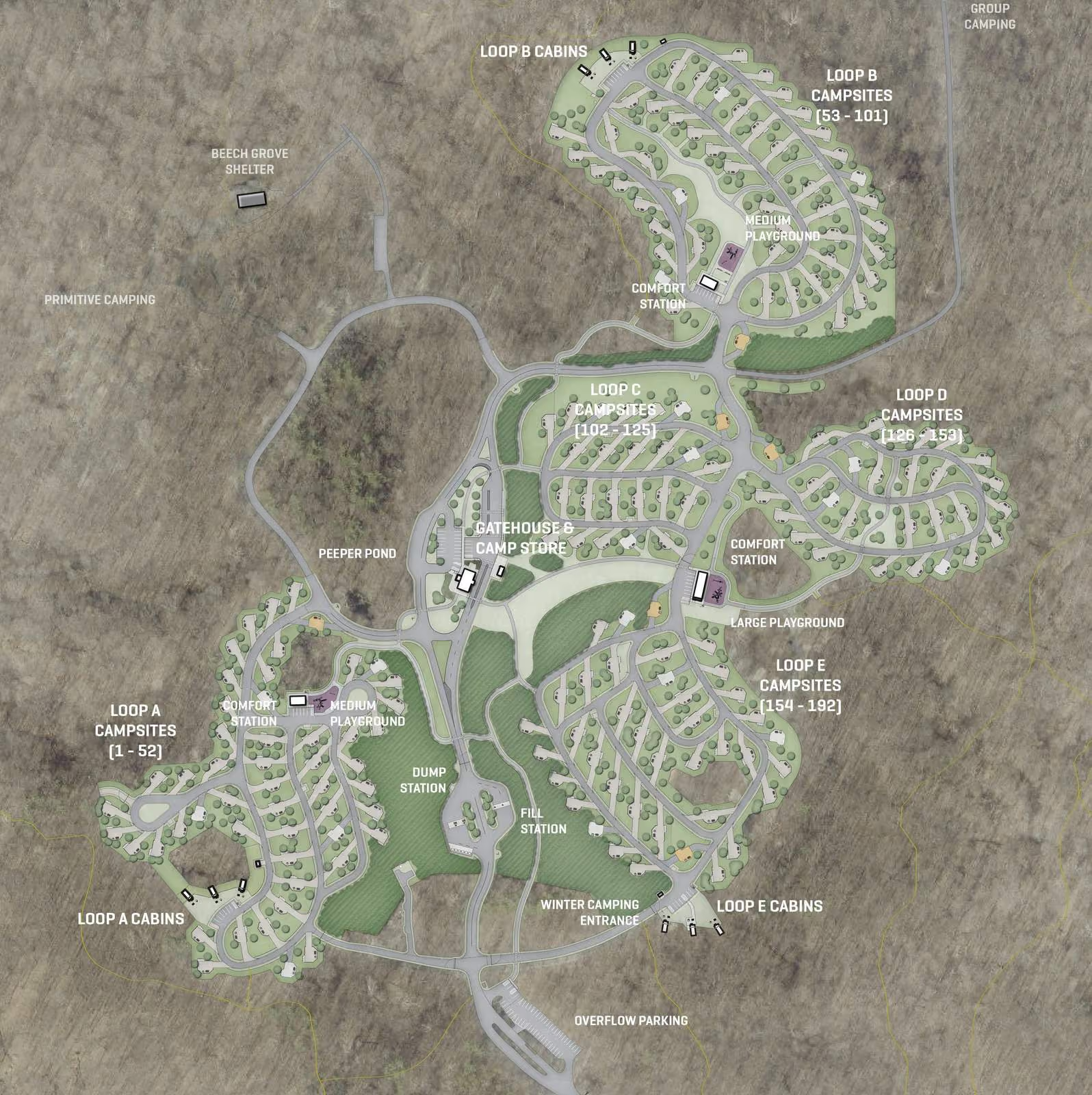
The newly designed campground will feature a larger footprint spanning 65 acres, housing 192 modern campsites equipped with full hookups for electricity, water, and sewer. Measuring approximately 32 by 40 feet, the modern sites are built to comfortably accommodate larger recreational vehicles. Additionally, 32 primitive campsites will remain available for tent camping, and the park’s existing group camps will continue to welcome visitors.
To enhance the overall visitor experience, the $25 million project also includes building a new gatehouse, a camp store, and three modern comfort stations equipped with adjacent playgrounds. Substantial landscaping and tree planting initiatives are integrated into the master plan to restore the natural forest character of the campground area. True to local roots, the Indiana DNR Division of Forestry will supply timber used for constructing the new gatehouse and camp store.
“McCormick’s Creek State Park holds a special place in the hearts of so many Hoosiers, and the loss of the campground in the 2023 tornado was felt across our entire state,” added Brandt Baughman, Director of Indiana State Parks. “Our team has worked thoughtfully and carefully to design a new campground that honors the park’s history while creating space for future generations to explore, connect, and make memories.”
Construction bids for the infrastructure, including buildings, electrical grids, water lines, and sewer systems, are scheduled to open on Oct. 20. State officials anticipate that the newly rebuilt campground will officially open to the public in the late summer of 2028.
Detailed information regarding the 2023 tornado and ongoing recovery efforts can be found online at on.IN.gov/McCormicks-Recovery, while general park details are available at on.IN.gov/McCormicksCreek.
Cataract Lake Community Center strives to be resource, struggles to get people in the door
The Cataract Lake Community Center reopened about a year and a half ago, with hopes to build trust and offer meaningful resources to the community.
The center offers monthly free community dinners, emergency food assistance and free resources, such as hygiene products, diapers, formula, clothing and mobility aids like crutches and walkers. The building is also open for people to come hang out and play and hosts regular events like ice cream socials and LEGO® nights.
The monthly dinners are held on the third Wednesday of each month from 5-7 p.m., drawing anywhere between 45 and 100 attendees. The center’s board president, Patricia Chappell, said the dinners are a chance for all people to come together for a meal.
One of the center’s greatest impacts, she said, is showing respect. The center opens its doors to “people who are already struggling, who are already in a situation of uncomfortableness, who are being judged, who are being looked down upon, who are leery,” Chappell said.
Focusing on being non-judgmental, the center aims to avoid the stigma or ridicule faced by people who are living in poverty or dealing with addiction.
“I wish people understood that they’re good people,” board vice president Christal Perrine said. “They deserve to have things as well. They deserve food. They deserve kindness. They deserve people to be friendly to them.”
Chappell said the center is important in giving aid to community members in need but is in “desperate” need of food and hygiene donations and involvement. Chappell said she wants to see more people come to the monthly dinners, join as volunteers and tell the center what resources, services or events they want to have.
The center tries to cater to those who may be experiencing homelessness or don’t have the resources to cook in a kitchen by offering food items that can be easily made over an open pit or with boiling water. It also opens up during tornados or extreme warm or cold weather as a place where people can find shelter.
“Last year we stayed open,” Chappell said. “There was about five days where it was extremely cold. My family actually stayed up there for three days straight. We slept on the floor to keep the building open for people to come in and provided coffee and soups and different things in case people were cold.”
Chappell said her goal is to have organizations like the IU Health Owen County Women, Infants and Children office, Division of Family Resources or local health department come to the center and provide outreach and services to the “really underserved area.”
Transportation is a large barrier for some, she said, and some kind of shuttle to take those without their own transportation to the grocery store, a job interview or doctor appointments would help people get on their feet.
“You’d be really surprised how many people don’t have internet,” she said. “They don’t have a home. They’re living in tents in the woods, so they don’t have cars. They don’t have a means to apply (to jobs) or obtain services outside that little bitty area.”
Working with and volunteering for the center has changed the way Chappell thinks about the underserved people in the community, she said. Learning just how many are facing generational poverty, homelessness and addiction was “heartbreaking.”
“There's a lot of children, an enormous amount of children in that area that nobody knows about, that are living in the woods, that are living in tents, that are not going to school, that are hungry, covered in sores,” Chappell said.
Not only does center leadership hope to attract more volunteers, as the most current ones are the seven board members, but also more users of the community building. Chappell said the center has tried some programs that haven’t quite taken off. Perrine said more people are starting to come to the dinners and use the center, but she wants to know what the community wants.
In the future, Perrine said she would like the center to be open at least five days a week. With more volunteers, donations and community members offering resources, programs and events for the center, Chappell hopes the facility will have the stability it needs to be open and stay open more often.
“If we had more resources and more ability to get resources out there, I do believe that people would see a change,” Chappell said of the underserved community.
The nonprofit leases the building from the Jackson Township Trustee in Owen County, who currently covers rent and helps with utility bills. But, in March 2027, the center will fully fund itself and needs donations to last.
Perrine and Chappell both want the community to know that it’s not the same center that’s been open off and on for five to 10 years and broke the community’s trust with a lack of transparency. It has new leadership.
“Our main goal is a community,” Perrine said. “We’re not doing this for us, we’re doing this for the community. We want them to come in. We want them to know that we’re there for them.”
The center is open from 3-7 p.m. on the first and third Sunday of each month, 5:30-7:30 p.m. Wednesdays, 4-7 p.m. Fridays, 7-10 a.m. on the first and third Saturday of each month and 4-6 p.m. on the second and fourth Saturday of each month, according to its website.
The center, located at 5530 State Road 42 in Poland, IN, regularly posts updates and events on its Facebook page.
“I want to see that place full of people,” Perrine said. “I want to see kids in there playing. I want to see seniors in there enjoying coffee, playing cards. I want to see adults socializing, everybody just getting together.”
Get the paper delivered plus more?!
Visit our memberships page to learn how you can get the newspaper delivered straight to you for as low as $5 per month - plus many more perks! Your support means the world to us.

.avif)
.png)