We're "ON" It! - The Owen News
The Owen News is your trusted source for comprehensive, reliable and unbiased local news and information in Owen County and surrounding areas, including Spencer, Gosport and more.
Stay in the loop!
Subscribe to The Owen News and receive news alerts and other important notifications directly to your inbox! Or log in below if you've already subscribed.
Welcome back, user.name!
Readers like you make our nonprofit news organization possible. Have you considered advertising with us? Also, as a monthly member, you can get The Owen News delivered to your home for as low as $5 per month!
Featured Stories



.avif)


Support The Owen News!
Your support fuels independent journalism and community engagement. As a recurring monthly donor, you can get newspapers delivered straight to your doorstep (if you'd like)!
Latest Stories


The Data Center Debate comes to Owen County
The Aug. 20th meeting of the Owen County Board of Commissioners started off with a warning: everyone stay civil, everyone stick to their three minutes, if they don’t they will be removed. Commissioner Sam Hobbs recalled the Aug. 6 meeting, where decorum was harder to come by, and apologized on behalf of himself and the other commissioners for letting the previous meeting get out of hand.
“We aren’t always going to agree on everything, and we can disagree, but we don’t have to get nasty about it,” Hobbs said.
Public comments stayed civil, but the opinions of nearly every resident were similar. Nine residents expressed their support for either a temporary moratorium on data center development in Owen County or an outright ban. Concerns stated were noise, excessive water use, electricity costs, and property value decreases.
While there are currently no plans from any developers to build data centers in Owen County, many residents expressed their concerns that without a formal prohibition, data center development could happen at any moment.
Local resident Mike Broach has seen the results of this development come to pass in his former home of Boone County. The LEAP facility including a Meta data center began construction two miles from his former home near Lebanon. He moved to Owen County last December from his family home to get away from the mass construction that he says disrupted his life.
“We had started noticing infrastructure changes: a lot of construction, basically on our front doorstep,” he recalled. “The main highway into town changed from a two land road into a four lane road.”
Broach also remembers the constant traffic that was involved.
“They had specific construction routes, but those routes were busy and congested, so those guys would juke these routes . . . and so that puts construction traffic driving right by the places they shouldn’t be driving. . . one of those places was my home,” he added.
Another concerned citizen, Judy Morris took it upon herself to investigate the data center issue after hearing about devastating effects on other rural communities. At this point, she told The Owen News that she would rather be enjoying her retirement, but she is concerned about what the future would bring if a data center came to Owen County.
“Just looking at stuff, how could we bring [this] stuff into our county without messing up our farmland, messing up all this rural beauty that we have around us and just what everybody's here for,” she said. “You're gonna run everybody out with it.”
Her investigations led her to send three messages to the Owen County Board of Commissioners citing sources from government reports around the state. The first email contained information about data center water usage and the effects on groundwater, the second information about the effects a data center build can have on farmland and the third, information about environmental impacts of a so-called “closed-loop” water cooling setup.
The State of the State
Data center development is accelerating across the state and the scale of some projects is staggering.
According to market research firm Cleanview, Indiana currently has 23 operating data centers with an electrical capacity of 1352 megawatts. The largest operating data center, a Meta-owned facility in Jeffersonville, consumes 108 of those megawatts alone. In comparison, the planned Takanock-owned facility in Elkhart County is estimated to consume a whopping 1500 megawatts alone. According to Cleanview, there are 130 planned data centers for Indiana with a total estimated capacity 10 times higher than current consumption.
If all these data centers are built, their total electricity usage at full capacity would account for 13.2% of the entire state of Indiana’s total 2024 electricity use (an estimated 13,140,000 mWh for the data centers vs 99,219,607 mWh of state electricity use per a 2024 EIA report.)
At an EDC Access meeting on Aug. 21 at the Owen County Methodist Church’s In God’s Arms (IGA) building, State Treasurer Daniel Elliot spoke at length about how much data centers could benefit Indiana residents and how, in his opinion, short-sighted that it is to try to ban them.
“I'll give you a perfect example,” he said to a crowd of community leaders and local government officials. ”Indianapolis said, they were gonna do a data center, and they said, no, we're not gonna do it–too much heat, too many people get mad at us. They made a bad business decision based on politics. Morgan County, where I'm from, they were already in the middle building one. They said, okay. We'll just make this one bigger. So who benefited? Morgan County did.”
Elliot was most likely referring to a proposed Google project in Franklin Township near Indianapolis that Google cancelled due to strong local backlash, and an approved 390 acre Google-backed project near Monrovia in Morgan County.
Keeping up with the neighborhood
According to 2025 reporting from the Morgan County Correspondent, there was strong local opposition to the development due to non-disclosure agreements signed by county officials with Google and the same concerns about utility use and property value decline cited by Owen County residents. Morgan county officials went through with the proposal despite its unpopularity citing the increases in income tax and the deal they made with Google to provide donations to local charities in lieu of higher tax rates. Officials there stated that even if they were voted out of office due to the unpopularity of their plan, they considered the additional income coming into the county to be worth the sacrifice.
2025 Reporting from Fox 59 details a similar story in the rural Franklin Township of Marion County: local officials signing non-disclosure agreements, farmland getting rezoned for data center use, and local residents voicing grievances. If Google hadn’t formally withdrawn their proposal, Franklin township likely would have had their own 460 acre Google data center to contend with.
On Aug. 19, 2026, Marion County banned all new data center construction through Dec. 31, 2027. Marion County data center projects already in progress can still continue, but new construction cannot begin until at least January of 2027.
Meanwhile, back in Owen County
Broach brought example legislation before the commissioners at their Aug. 6th meeting. The draft he presented was based on a Marshall County ordinance that bans all data center development in the county. Since that meeting, he also presented example ordinances to the Gosport Town Council and the Spencer Town Council.
Broach’s proposal is not the only one being considered by the county. The first, a moratorium on data center development based on a similar Putnam County ordinance and the second is the total ban on data center development first presented by Broach.
“I’m not asking [them] for a moratorium, I’m asking them to ban it,” he said. “People are concerned that with a ban it can’t be undone. . . essentially a ban can be overturned at any time. With a moratorium it guarantees it’s going to be undone.”
The process to pass either ordinance requires a legal review from county officials, the ordinance to be passed by the Owen County Plan Commission, and finally a motion to pass the ordinance by the commissioners.
In response to worries about transparency in relation to land development, all three commissioners promised at their Aug. 20th meeting to avoid signing any non-disclosure agreements with any potential future data center developers.
Almost half of Indiana counties currently have ordinances that prevent new data center development but state legislation has the ability to override them.
The 2026 Indiana State Legislative Session included House Bill 1333 that would allow developers to use property zoned as farmland for data center development. If that bill had been passed, data center developers could buy farmland directly from the owner and begin construction, bypassing any rezoning process that has prevented construction in other counties. While most residents are in favor of a county ordinance that would prevent data center construction, a state law like House Bill 1333 or a state law preventing data center bans would supersede it.
“The problem is, if they go down [that road] then we can moratorium and resolution all we want and it won’t matter,” commissioner Norm Warner said.
Alternative ordinances such as water use limits for business use, noise ordinances or electricity use limits were suggested at the meeting as ways that Owen County could be made inhospitable to data center development without creating a ban that would be overturned at the state level.
Still, most concerned residents want to see official county action taken to stop data centers now.
Judy Morris plans to continue her pleas to the commissioners to keep data centers out of Owen County.
“[The benefits of data centers] all seem great until you've got no more clean water to drink,” Morris said. “I’m hoping that more people will get involved and that I won't be up there by myself.”
Broach feels similarly and thinks the aggressive pace of datacenter buildout is excessive.
“I think that the destruction outweighs the benefit heavily,” he said. “At the very least I think we should slow down and think [about] what we are doing.”
S-OCS invests in new teachers through mentor program
Starting a teaching career is an exciting milestone, but stepping into a classroom for the first time also comes with plenty of questions, challenges, and opportunities to learn. At Spencer-Owen Community School Corporation (S-OCS), new teachers don’t have to navigate those first experiences alone.
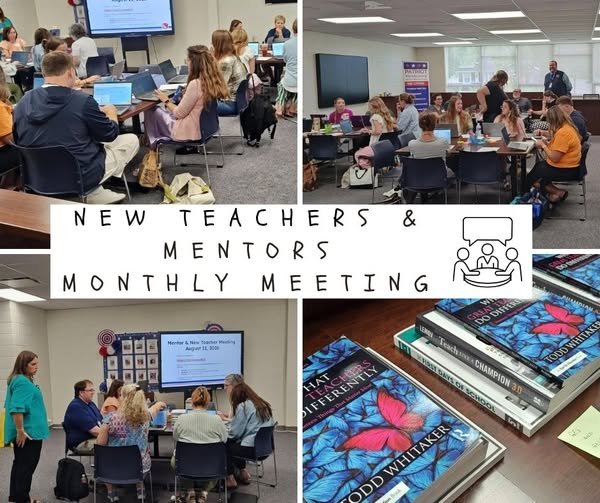
Through the district’s New Teacher Mentor Program, beginning educators are paired with experienced teachers who provide encouragement, guidance, and practical support as they begin their careers with S-OCS.
Throughout the first semester, new teachers and their mentors meet monthly to learn together, share ideas, ask questions, celebrate successes, and work through some of the challenges that naturally come with being new to the profession.
The goal is simple: make sure new teachers know they have people in their corner.
Providing strong support during the early years of teaching can help new educators build confidence, develop effective classroom practices, and feel connected to their school community. Mentors also provide something that can’t always be found in a handbook or professional development session…the perspective and reassurance that come from experience.
As part of the program, new teachers and mentors are reading and discussing “What Great Teachers Do Differently” by educator and author Todd Whitaker. The book focuses on the practices and mindsets that distinguish highly-effective educators.
Among its central themes is the importance of relationships. Great teachers understand that how they interact with students matters and that treating every student with respect helps create a classroom where children feel valued and ready to learn. Whitaker also emphasizes that effective teachers focus on the things they can control, maintain high expectations, and consistently make decisions based on what is best for students.
Another important message is the power of consistency and intentionality. Great teachers don’t simply rely on programs or strategies to create successful classrooms. They recognize that their daily actions, attitudes, expectations, and relationships have a tremendous influence on the culture of their classrooms and the success of their students.
Those ideas provide a starting point for meaningful conversations between Spencer-Owen’s new teachers and their mentors.
The monthly meetings, however, are about much more than discussing a book. They provide an opportunity to build relationships among educators and create a network of support across the district. New teachers can talk openly about what is going well, ask for advice when something isn’t working, and learn from colleagues who have experienced many of the same challenges.
The program also gives veteran educators an opportunity to share their knowledge while encouraging the next generation of teachers.
At Spencer-Owen Community Schools, supporting new teachers is an investment that reaches far beyond the individual educator. Teachers who feel supported and confident are better equipped to create positive classrooms, build strong relationships with students, and focus their energy on teaching and learning.


Quentin Lamont Porter sentenced to 60 years in the murder of Malik Darea Sims
Correction note:
A previous version of this article incorrectly identified Sims and Porter in the third paragraph.
A years-long legal process including postponement, a mistrial and finally a seven-day legal proceeding, led to the murder conviction of Quentin Lamont Porter. On Wednesday, the Owen Circuit Court I handed down its sentence: 60 years.
Porter was convicted on five counts related to the killing of Malik Darea Sims including theft and identity deception, but the sentences for each would be served concurrently, making the 60-year sentence for murder the maximum time served.
While Judge VanDerMoere II handed down the sentence, the proceedings in this case are not yet over. Porter and his public defender have filed an appeal, and new public counsel will now be provided to Porter as he seeks to appeal his case in the Indiana Appellate Court. If the appeal is granted, Porter's public defender would need to prove that there was a mistake in the legal proceedings that convicted and sentenced him. If the appeal is denied, Porter will report to an Indiana Correctional facility to begin serving his sentence.
Read 7 days of Owen News trial coverage:
Artist Steve Adams brings color and history to Spencer’s canvas
Whether walking through the doors of Spencer Elementary School (SES) or taking a leisurely stroll past the shopfronts of downtown Spencer, residents across Owen County have undoubtedly encountered the vibrant, detailed brushwork of artist Steve Adams.
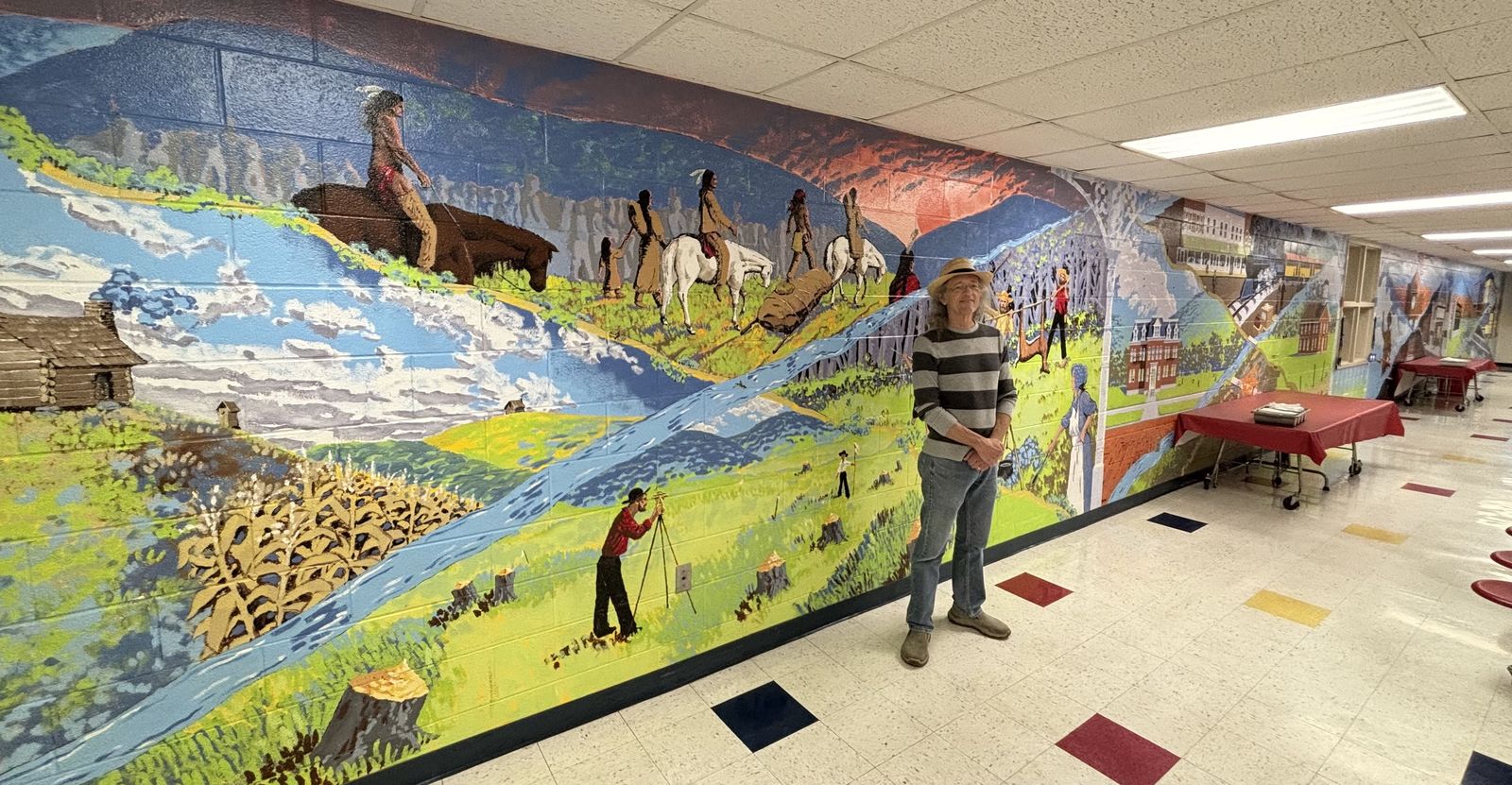
A longtime Spencer resident who recently completed his latest mural at SES, Adams has spent countless hours turning blank brick, plaster, and glass into cherished public landmarks. His journey spans commercial success as a long-time book illustrator, a deep passion for historical preservation, and a familiar presence along local backroads on his daily bicycle rides.
Reflecting on how he originally landed in Spencer, Adams recalled a period of transition after returning to the States from living abroad in Belize.
“I grew up on the northwest side of Indianapolis, near Eagle Creek Park,” Adams said. “I went to college in Bloomington and wanted to live down this way. When we came back from Belize, I didn’t have a job, and we just needed a place that I could buy for cash. We found this house, liked it enough, and could afford it. So, we ended up here.”
His affinity for drawing began long before setting up roots on the south side of the town of Spencer. Like many artists, the drive to sketch emerged early in his childhood.
“I’ve always liked to draw,” Adams said. “It’s mostly what I did in school when I was supposed to be paying attention to the teachers.”
That childhood inclination was fostered by a creative household and inspiring educators.
“Everybody in my family does some kind of artwork as a hobby,” he noted. “And I had some great teachers in junior high and high school.”
That foundation led Adams to Indiana University in Bloomington, where he majored in art, ultimately turning his lifelong passion into a nearly two-decade career in commercial publishing.
“I was a book illustrator for 18 years at AuthorHouse,” Adams said. “All kinds of children’s books, book covers, all original artwork. I wouldn’t even guess how many books I’ve been a part of through the years.”
It didn’t take long for Adams’ illustration work to expand onto larger community canvases around Owen County, starting with SES.
“The first one at Spencer Elementary was about 20 years ago,” Adams recalled. “That was the big mural in the cafeteria showing the courthouse dome and different scenes around town. I’ve talked to adults now who remember watching me paint that when they were kids.”
Working in high-visibility environments naturally draws curious onlookers, a dynamic Adams warmly embraces, especially when young kids stop to watch him create.
“Some people get really nervous about painting in public, but I’m fine with it,” he said. “I just try to be friendly and interact a little bit with the kids. Maybe it gets them interested in art outside of the normal workaday world.”
Those spontaneous interactions often leave lasting impressions across generations.
“When I’m outside painting storefront windows around the [courthouse] square, I like to give a kid the brush and let them paint a little bit,” Adams shared. “It lets them feel like they’re a part of it.”
Creating public art requires a balance of audience consideration and precise preparation.
“If I’m creating something for the school, I work up the design, submit it, and let administrators go through the process of letting me know what changes they want, keeping it lighthearted and kid-friendly,” Adams explained. “If I’m doing window art around the square, a lot of times I’ll look at ideas online, and for Christmas especially, I like to look at vintage holiday cards for inspiration.”
Translating a hand-drawn sketch onto a massive wall requires patience and geometry, a stage Adams considers the most labor-intensive part of the job.
“The most time-consuming part is making the grid and transferring the design on there to get it all right,” he said. “I draw the grid on the wall and use that as a guide.”
When asked about the total time investment required for a large mural, Adams smiled.
“I’m really terrible with tracking time,” he laughed. “I’ll spend two or three hours doing an initial sketch, an hour or so making revisions, and after that, it might take 12 to 18 hours or so to paint the final mural depending on the scale.”
Near the tail end of the 2025–2026 school year, Adams put the finishing touches on a massive gymnasium mural at Spencer Elementary School featuring the iconic SES Wildcat. More recently, he’s been spotted in the community of Gosport, adding his signature painted artwork to storefront windows for several local businesses.
When he isn’t holding a paintbrush or a grid pencil, Adams is an avid cyclist who logs serious mileage on two wheels.
“I used to ride back and forth to work every day that the weather would allow it; that was always the best part of the day,” Adams recalled. “Now, every day I try to ride out around McCormick’s Creek State Park and back, or out toward Owen Valley Winery. I ride about 15 miles a day, but I’d really like to do more.”
That dedication to cycling frequently translates into long-distance touring trips.
“I’m heading out on a bike ride up to Lake Michigan and back, starting from my mom’s house in Indianapolis,” Adams shared. “It’s about 150 miles up there and takes about five days. I pack my tent and camp wherever I can find a spot. A couple of years ago, I did a similar route from Dayton up to Lake Erie and over to Cleveland.”
To wind down at home without picking up a pencil, Adams turns to music.
“I like to sit around and play my guitar,” he said. “I took that up again while working as an illustrator because it was nice to come home and do something creative without having to draw. I took lessons as a kid, put it away for 50 years, and then got back to it. I really enjoy it.”
Looking ahead, Adams remains particularly drawn to projects that help honor and restore local heritage.
“I really like anything that has to do with preserving history, like old ghost signs or building lettering that needs to be touched up,” Adams expressed, mentioning past restoration work inside the Spencer Pride commUnity center in downtown Spencer. “Anything that helps preserve the historical fabric of the town is something I’m passionate about.”
At home, Adams shares his life with his wife, Emilia. Together, they have two daughters and three granddaughters.
Even after decades of creating, completing a major work brings a familiar mix of self-critique and quiet pride.
“When I finish, I mostly look at all the flaws,” Adams admitted with a laugh. “That’s pretty much what I see first. But it’s also satisfying to see the finished work out in the world. It’s the end of an adventure before moving on to the next one. You learn a few things along the way.”
For aspiring young artists across Owen County hoping to follow a similar path, Adams offers straightforward, practical advice:
“Just practice, enjoy the process, and draw a lot,” Adams advised. “Go outside, draw what interests you, copy comics, or study artwork you love. It’s the best way to learn.”
Gosport Lazy Days 2026
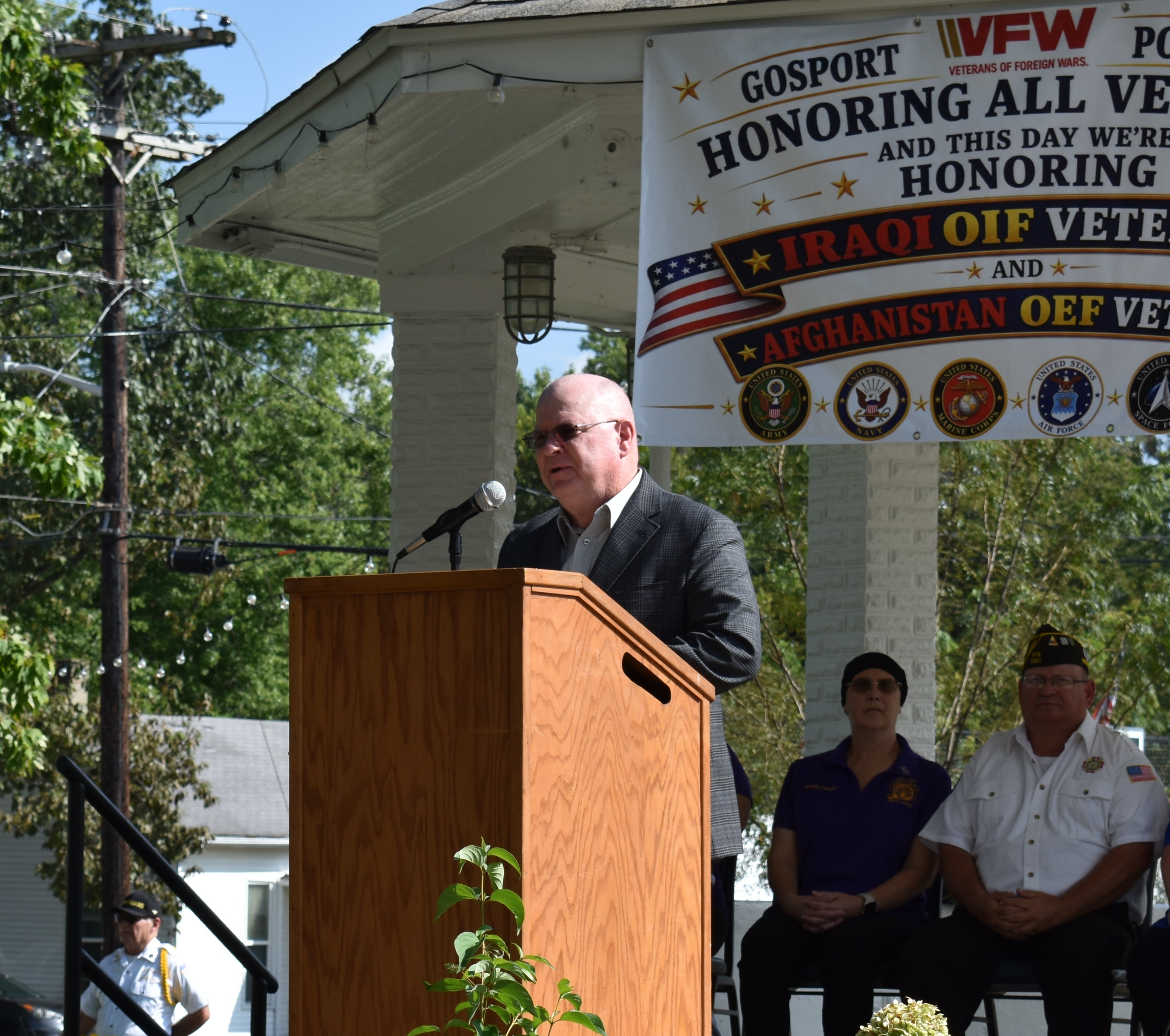
A wet and windy start may have delayed the opening ceremonies, but it didn’t dampen the enthusiasm of the crowd that gathered on Thursday, Aug. 13 to kick off the 2026 Gosport Lazy Days festival.
The Outstanding Citizens of the Year, chosen by the Lazy Days Committee were Shelly Leonard and Craig Brighton.
The Senior Citizens of the Year were Linda Holsapple and Ernie East.
Little Miss and Little Mister went to Knox Truesdel and Chloe Fauber, respectively.
Festivities continued into the night with music on the town park bandstand.
Friday continued the activities with the Tim Dittemore Memorial Car Show, the Gosport VFW Fish Fry and three musical acts on the bandstand.
Saturday started early with the Gosport Lions Club 5k Race and continued with the annual Bike Race, Baby Contest and Sidewalk Chalk Art Contest.
One o’clock began the Gosport Lazy Days Parade with floats representing organizations from Gosport, greater Owen County and beyond.
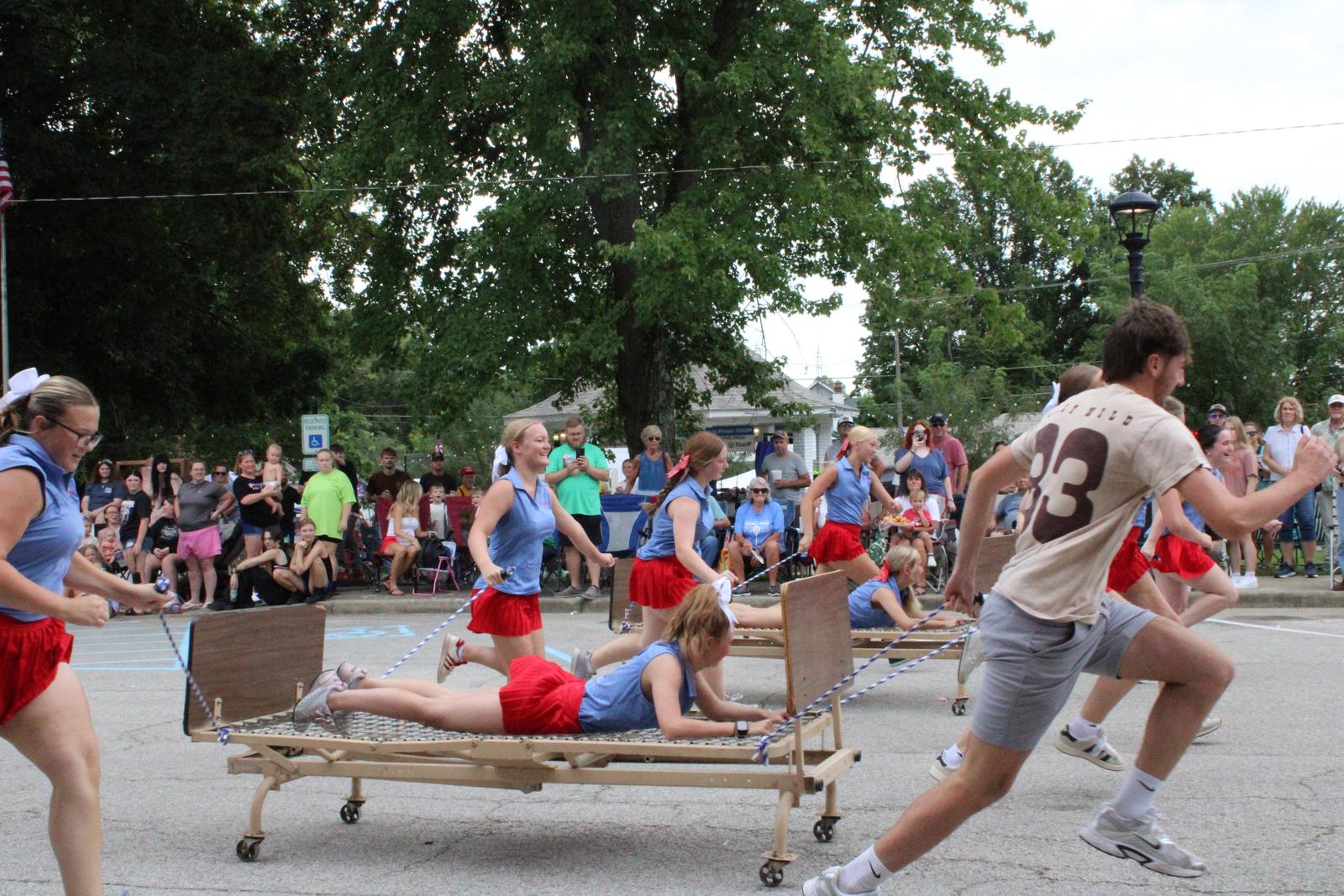
The parade’s end brought what may be Gosport Lazy Days’ most signature event: the Main Street Bed Races.
For the uninitiated, the Bed Races consist of two teams of five, four of whom pull an old wheeled hospital bed without a mattress, and one of whom lies flat on the bed and holds on for dear life. The first makeshift sleigh-bed team across the finish line wins the race and a double-elimination tournament determines the champion of the event.
This year, the Bed Races were renamed in memory of the longtime host of the event, Kip Seidenstucker. In his place this year was his daughter Kassie Smithey, who recalled how much her father enjoyed hosting the Bed Races each year and how much he would have appreciated the event being named in his honor. The champions this year were a team drafted from the crowd by the Indiana Dinosaur Museum of South Bend, IN.
Get the paper delivered plus more?!
Visit our memberships page to learn how you can get the newspaper delivered straight to you for as low as $5 per month - plus many more perks! Your support means the world to us.